History of Tarot Cards
Playing cards first entered Europe in the late 14th century, probably from Egypt, with suits very similar to the tarot suits of Swords, Staves, Cups and Coins (also known as disks, and pentacles) and those still used in traditional Italian, Spanish and Portuguese decks.
The first known documented tarot cards were created between 1430 and 1450 in Milan, Ferrara and Bologna in northern Italy when additional trump cards with allegorical illustrations were added to the common four-suit pack. These new decks were originally called carte da trionfi triumph cards, and the additional cards known simply as trionfi, which became "trumps" in English. The first literary evidence of the existence of carte da trionfi is a written statement in the court records in Ferrara, in 1442. The oldest surviving tarot cards are from fifteen fragmented decks painted in the mid 15th century for the Visconti-Sforza family, the rulers of Milan.
Special motifs on cards added to regular packs show philosophical, social, poetical, astronomical, and heraldic ideas
The original purpose of tarot cards was for playing games, the first basic rules appearing in the manuscript of Martiano da Tortona before 1425, and the next from the year 1637. The game of tarot has many cultural variations. In Italy the game has become less popular. One version named Tarocco Bolognese: Otocento has survived and there are still others played in Piedmont; but the number of games outside of Italy is much higher. The French tarot game is the most popular in its native country and regional tarot games—often known as tarock, tarok, or tarokk—are widely played in central Europe
Each card possesses a pictogram and title that represents a specific concept. The belief of divinity associated with Tarot focuses on the prospect that whatever cards are dealt to the participant will be revelatory of his current psychological dilemma.
Divination using playing cards is in evidence as early as 1540 in a book entitled The Oracles of Francesco Marcolino da Forlì which allows a simple method of divination, though the cards are used only to select a random oracle and have no meaning in themselves. But manuscripts from 1735 (The Square of Sevens) and 1750 (Pratesi Cartomancer) document rudimentary divinatory meanings for the cards of the tarot as well as a system for laying out the cards. Giacomo Casanova wrote in his diary that in 1765 his Russian mistress frequently used a deck of playing cards for divination
Tarot cards would later become associated with mysticism and magic. Tarot was not widely adopted by mystics, occultists and secret societies until the 18th and 19th centuries. The tradition began in 1781, when Antoine Court de Gébelin, a Swiss clergyman, published Le Monde Primitif, a speculative study which included religious symbolism and its survival in the modern world. De Gébelin first asserted that symbolism of the Tarot de Marseille represented the mysteries of Isis and Thoth. Gébelin further claimed that the name "tarot" came from the Egyptian words tar, meaning "royal", and ro, meaning "road", and that the Tarot therefore represented a "royal road" to wisdom. De Gébelin wrote this treatise before Jean-François Champollion had deciphered Egyptian hieroglyphs, or indeed before the Rosetta Stone had been discovered, and later Egyptologists found nothing in the Egyptian language to support de Gébelin's fanciful etymologies. Despite this, the identification of the tarot cards with the Egyptian Book of Thoth was already firmly established in occult practice and continues in to the present day.
Usage: Anyone, wide usage
Accuracy: Increases with Usage but not Highly accurate for personal use
Safety: High
Tarot cards are used nowadays for divination purposes and consist usually of 78 cards. 22 Major Arcana and 56 Minor Arcana.
In simple terms.
The Major Arcana are strong influences from the spiritual aspects of your life. Connections with your guide for example. They signify stronger meanings than the Minor Arcana. Their appearance in a spread indicates more attention is required than normal.
The Minor Arcana number 1 to 10 plus the 4 'picture' cards.
While less spiritually significant these cards are about the day to day events we go through.
there are 4 suits.
The Cups: Emotions, Relationships, Romance and Spirituality.
The Pentacles: Comfort, Security, Finances.
The Swords: Disagreements, Conflicts, Disturbances and uncomfortable situations.
The Wands: Career, Work, Moving.
The cards come out upright or reversed in a Spread. Reversed usually means that the issue or situation has more complications and difficulties taking longer to resolve.
How We Use Tarot
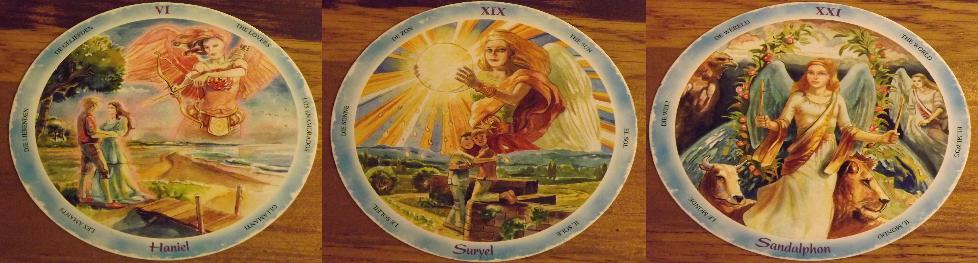
Tarot …………..well known and widely used. We love the Shining angel Tarot cards. Miggin also uses the Oracle Cards.
An age old tool for assisting in focusing information from guides through pre-defined messages and information. Often a person develops an affinity for a set of cards but this is more to do with the connection with their spirit guide.
Tarot is one of the more recent types of tools used for readings. Anyone can learn but only experience and understanding provide useful answers to questions.
We use Tarot as a fun way to provide the “basics” in a reading or demonstration on one of our online websites we work on.
We both have different sets of cards. Jason prefers only the shining angel Tarot deck which are round and provide a strong connection for him...
Miggin has a number of decks for readings purposes and prefers to rotate them according to her intuitive feel of the situation. She also has an Astrology Reading Card set. These are fewer in number but have a different purpose and energy attached which is often extremely informative for the person being read.
There are a small number of spreads we do. 1 card, 3 card (past, present, future) , 5 card (past, present, future plus influences) or 10 card Celtic Cross.
We do email tarot readings upon request.