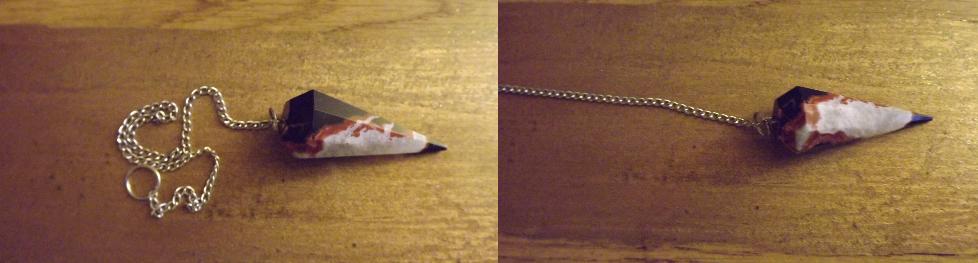
History Of Pendulums
Pendulum motion appears in a variety of religious ceremonies as well as for divination and dowsing. The swinging incense burner called a censer, also known as a thurible, is an example of a pendulum. Pendulums are also seen at many gatherings in eastern Mexico where they mark the turning of the tides on the day which the tides are at their highest point.
A pendulum of crystal, metal or other materials suspended on a chain is sometimes used in divination and dowsing. In one approach the user first determines which direction (left-right, up-down) will indicate "yes" and which "no" before proceeding to ask the pendulum specific questions, or else another person may pose questions to the person holding the pendulum. The pendulum may also be used over a pad or cloth with "yes" and "no" written on it and perhaps other words written in a circle. The person holding the pendulum aims to hold it as steadily as possible over the center and its movements are held to indicate answers to the questions.
In the practice of radiesthesia, a pendulum is used for medical diagnosis.
A 1986 article in Nature included dowsing in a list of effects which until recently were claimed to be paranormal but which can now be explained from within orthodox science. Specifically, dowsing could be explained in terms of sensory cues, expectancy effects and probability.
Skeptics and some supporters believe that dowsing apparatus has no power of its own but merely amplifies slight movements of the hands caused by a phenomenon known as the ideomotor effect: people's subconscious minds may influence their bodies without their consciously deciding to take action.
This would make the dowsing rods a conduit for the diviner's subconscious knowledge or perception; but also susceptible to confirmation bias.
Pendulums should not be used as a psychic tool for your own personal use as it is inaccurate. When the questioner is emotionally involved with the question and answer confirmation bias happens. The pendulum is a means of connecting to the energy of the user or spirit and therefore can give erroneous and inaccurate information. As with any tool it is only as good as its user.
Usage: Anyone with training and practice
Accuracy: Mixed (depends upon experience), not recommended for personal use
Safety: Medium to high
Pendulums
Pendulums…… simple and effective for fast answers.
We use pendulums for the most simple questions. This is fun watching as our guides push the pendulums and you can see it happening in front of your eyes!! its cool and quick but we keep it to simple yes/no questions.
We will be using pendulums for more involving purposes in the future.
Firstly for divination in a simple manner. Answers to YES/NO questions etc.
If you want to use a Pendulum follow the instructions below:
Clear your mind, focus on your question and allow your guide to give the answer in the way the pendulum moves. It may take time to get the rythym right the first few attempts.
Secondly for healing purposes. A very effective tool for focusing healing energy.
Thirdly for removal and cleansing. Just like any spiritual tool this is ideal for cleansing and removals.